

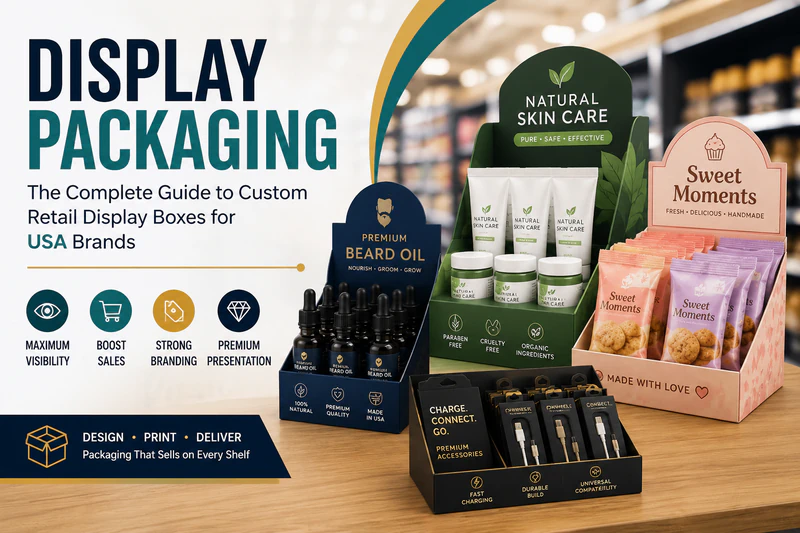
In a busy retail environment, a product rarely gets unlimited time to make an impression. Shoppers move quickly, compare multiple options, and often decide within seconds which product deserves a closer look.
That is why packaging in retail has to do more than simply protect what is inside.
Display packaging combines product protection, organization, branding, and presentation in a format designed to help products stand out where buying decisions happen. Whether placed on a checkout counter, retail shelf, promotional area, or store floor, a well-designed display can make products easier to notice, understand, and access.
For brands competing in the USA retail market, this matters. Great products can lose attention when they are poorly presented, while thoughtful custom display boxes can create a more organized and professional buying experience.
From cosmetics and confectionery to toys, personal care products, electronics, supplements, accessories, and promotional items, display packaging can be adapted to many industries and selling environments.
But choosing the right display is not simply about creating something colorful. The structure must fit the product, support its weight, provide enough visibility, communicate the brand clearly, and remain practical for retailers to handle.
This guide explores what businesses should know before investing in custom display packaging—and how the right combination of structure, materials, design, and branding can turn packaging into a valuable retail tool.
What Is Display Packaging?
Display packaging is designed to hold and present products in a way that keeps them visible and accessible to shoppers.
Unlike a standard shipping carton, which primarily protects products during transportation, retail display packaging becomes part of the selling environment.
Depending on the structure, it can organize multiple products while providing dedicated areas for branding, promotional messages, product information, or campaign artwork.
Common formats include:
- Countertop display boxes
- Display trays
- Dispenser boxes
- Shelf-ready displays
- Point-of-purchase displays
- Floor display units
Some designs serve only as retail displays, while others combine transportation and presentation. For example, certain shelf-ready cartons can arrive containing multiple products and then be opened or converted into a display for placement directly on the retail shelf.
The right format depends on what you sell, where it will be displayed, and how customers interact with it.
Why Display Packaging Matters at the Point of Sale
Imagine two similar products sitting a few feet apart.
One is loosely arranged among competing items. The other is organized inside a branded display with clear messaging, visible products, and a structure that makes picking up an individual unit easy.
Even before comparing the products themselves, the shopper experiences those presentations differently.
Effective display packaging can create several advantages.
Better Product Visibility
A display should help customers see the product rather than hide it.
Low front panels, open structures, tiered layouts, and carefully planned product arrangements can keep important areas of the individual packaging visible.
This is particularly useful for products that depend heavily on color, shape, branding, or visual variety.
Stronger Brand Presence
Retail shelves are shared spaces. A custom display creates additional branded real estate around your products.
Headers, side panels, front walls, and internal surfaces can reinforce brand colors, logos, product benefits, or campaign messaging.
Instead of several individual cartons competing independently for attention, the collection begins to look like one coordinated brand presentation.
More Organized Merchandising
Products that tilt, overlap, or become scattered can quickly make a display look neglected.
A properly sized structure helps maintain order as customers browse and remove products.
This is not just an aesthetic issue. Good organization can make products easier to understand and select.
Popular Types of Custom Display Boxes
Different retail environments require different structures. Choosing the correct format should begin with the product and its selling location.
Countertop Display Boxes
Countertop displays are compact units commonly positioned on checkout counters, reception areas, and other high-visibility surfaces.
They work particularly well for smaller products such as cosmetics, confectionery, accessories, personal care products, sample-size items, and other compact packaged goods.
Many include a raised header panel that provides additional branding space without interfering with product access.
For products suited to impulse purchasing, a well-positioned countertop display box can create valuable visibility within a relatively small footprint.
Display Trays
Display trays provide a lower and simpler presentation.
Instead of surrounding the products with large panels, they hold and organize them while allowing much of the individual packaging to remain visible.
They can be a strong choice when the product packaging already carries powerful branding and the main requirement is organization rather than additional promotional space.
Dispenser Display Boxes
Dispenser boxes are designed to release individual products through a controlled opening.
They can work well for smaller individually packaged items where customers or retail staff need quick access to one unit at a time.
The opening and internal dimensions must be engineered carefully. Products should dispense easily without allowing the remaining units to collapse or become disorganized.
Shelf-Ready Displays
Shelf-ready packaging combines logistical efficiency with retail presentation.
Products can arrive at the retailer inside a shipping configuration that is designed to convert into a display with limited handling.
For businesses supplying larger retail networks, this can be particularly useful because packaging needs to work not only for the shopper but also for the people stocking the shelves.
Floor Display Units
Larger campaigns may require more than a countertop or shelf display.
Freestanding floor displays can provide greater product capacity and a larger visual presence for seasonal campaigns, launches, promotional collections, or high-volume products.
Because these displays carry more weight and experience more customer interaction, structural stability becomes especially important.
Choosing the Right Material
The material affects strength, appearance, printing, weight capacity, and overall cost.
There is no universally “best” material—the correct choice depends on what the display needs to do.
Paperboard
Paperboard can provide a smooth printing surface and clean presentation for smaller, lighter products.
It can be suitable when high-quality graphics are important but the display does not need to support substantial weight.
Corrugated Board
For larger displays, heavier products, or structures that need additional strength, corrugated board can provide greater structural support.
Different flute profiles and board constructions are available, so material specifications should be matched to the actual packed weight and display design rather than selected by appearance alone.
Kraft-Based Materials
Kraft materials can create a more natural and understated visual style.
They can work particularly well for brands built around minimal, handcrafted, organic-inspired, or natural aesthetics.
However, appearance alone should not be used to make environmental claims. Sustainability depends on the complete material specification, sourcing, coatings, inks, adhesives, design efficiency, and available end-of-life options.
Structure Should Follow the Product
One of the biggest mistakes in custom packaging is choosing a box style first and trying to make the product fit afterward.
Display packaging should work in the opposite direction.
Before developing the structure, consider:
- Product dimensions and weight
- Number of units per display
- Retail shelf or counter space
- Product orientation
- Customer access
- Required branding area
- Dividers or internal supports
- Transportation requirements
It is also important to consider what happens after products begin selling.
A display may look impressive when completely full but become unstable or unattractive when only a few products remain. Good structural planning considers the entire retail cycle.
Matching the Display to the Selling Environment
A cosmetic collection placed on a beauty counter has different requirements from snacks positioned beside a checkout register or electronic accessories displayed on a retail shelf.
That is why effective custom retail display packaging should be developed around three things:
the product, the shopper, and the retail environment.
Small impulse products may benefit from compact countertop displays. Products shipped in larger quantities may be better suited to shelf-ready packaging. Collections with several variants may require dividers or tiered organization, while larger campaigns may justify freestanding displays.
There is no advantage in making a display more complicated than necessary.
The strongest structure is the one that presents the product clearly, supports it reliably, makes retail handling practical, and gives the brand enough space to communicate without overwhelming the shopper.
Once those fundamentals are right, the next challenge is turning that functional structure into a display customers actually notice and remember.
Designing Display Packaging That Gets Noticed and Sells
Once the basic structure works, the next challenge is visual communication.
Retail shoppers are surrounded by competing colors, products, messages, and promotions. A display does not need to be the loudest thing in the store, but it does need to communicate clearly enough to earn attention.
Successful display packaging brings structure and visual design together. The box should organize the products while helping shoppers quickly recognize the brand, understand what is being offered, and access the product without confusion.
The goal is not simply to make the display attractive.
The goal is to make it useful, recognizable, and persuasive.
Build the Design Around Brand Identity
A custom display should feel like a natural extension of the products it contains.
If individual product boxes use a particular color palette, typography, logo style, and visual language, the retail display should reinforce that identity rather than introduce an unrelated design.
Consistency can include:
- Brand colors
- Logo placement
- Typography
- Patterns or illustrations
- Product photography
- Brand messaging
- Overall visual tone
When several individual products are grouped inside one coordinated display, they can create a stronger collective presence than they would sitting separately on a shelf.
Give the Shopper a Clear Visual Hierarchy
One common mistake in retail display design is trying to communicate everything at once.
A header panel may contain the logo, product name, five benefits, promotional text, social media handles, icons, a QR code, and several images.
The result can be visual noise.
Instead, determine what the shopper should notice first, second, and third.
A simple hierarchy might be:
Brand → Product → Primary Benefit
Supporting details can appear elsewhere if necessary.
This approach allows customers to understand the display quickly without having to stop and read a large block of text.
Use Header Panels Strategically
The header is often one of the most visible areas of a countertop display box because it rises above the products.
That makes it valuable—but also easy to misuse.
A strong header might include a recognizable logo, a short product message, or one compelling benefit.
For example, a skincare display does not necessarily need a paragraph explaining the entire formulation on the header. A clear product category, recognizable branding, and one meaningful benefit may communicate more effectively from a normal shopping distance.
More information can remain on the individual product packaging.
Keep the Product Visible
Display packaging should promote the product, not compete with it.
This sounds obvious, but an oversized front panel or poorly positioned graphic can partially hide the products inside.
Before approving the design, evaluate the display when fully loaded.
Ask:
- Can customers clearly see the product?
- Is the product name visible?
- Are important colors or variants easy to distinguish?
- Can customers remove a unit comfortably?
- Does the display still look organized after several units are removed?
The answers matter more than how impressive the empty display looks in a digital mockup.
Custom Printing for Retail Display Boxes
Printing turns a structural display into branded retail space.
Depending on the material, design, quantity, and production requirements, custom display packaging can use different printing methods.
CMYK Printing
CMYK printing is useful for artwork involving multiple colors, illustrations, gradients, photography, and detailed graphics.
It gives brands considerable creative flexibility and is suitable for many colorful retail campaigns.
Pantone Color Matching
When a particular brand color needs tighter consistency, Pantone matching may be appropriate.
Color consistency becomes especially important when the display sits beside individually printed product boxes. Noticeably different versions of the same brand color can make the presentation feel less coordinated.
Finishing Options: Use Them With Purpose
Premium finishing can help a display stand out, but more finishing does not automatically mean better packaging.
Depending on the material and structure, options may include:
- Matte finishes
- Gloss finishes
- Spot UV
- Foil stamping
- Embossing
- Debossing
- Specialty coatings
For a luxury cosmetic display, a restrained foil detail or Spot UV logo may add visual interest.
For a colorful confectionery display, strong printing and a suitable coating may be more appropriate than luxury finishing.
The finishing technique should support the brand and retail environment rather than being added simply because it is available.
Organizing Multiple Products and Variants
Many displays contain more than one product.
A cosmetics brand may present several shades. A personal-care company may offer different fragrances. A confectionery display may contain multiple flavors.
Without proper organization, these variations can quickly become mixed together.
Custom dividers, compartments, slots, or tiered sections can help keep products arranged while making different options easier to identify.
However, internal components should not make restocking unnecessarily complicated.
A good display balances three needs:
organization, customer access, and retailer convenience.
How Design Can Influence the Shopping Experience
Packaging cannot force a customer to purchase a product, but it can remove obstacles from the decision-making process.
A shopper is more likely to understand a display when:
- The products are clearly visible.
- The branding is easy to recognize.
- The main message is simple.
- Variants are organized logically.
- Products are easy to remove.
- The structure looks clean and stable.
These may appear to be small details, but together they affect how professional and trustworthy the presentation feels.
Retail packaging works best when the shopper does not have to figure out how it works.
Common Display Packaging Design Mistakes
Even visually attractive displays can fail when practical details are overlooked.
Too Much Text
Retail displays are not brochures.
Large paragraphs and numerous claims can overwhelm shoppers, especially when viewed from several feet away.
Prioritize the information that matters most.
Hiding the Product
Large front walls, oversized graphics, or poorly positioned structural elements can reduce product visibility.
Whenever possible, test the display with the actual products loaded inside.
Weak Structural Support
A display that bends, tilts, or collapses as products are removed can quickly damage the brand presentation.
Material strength should match the total packed weight and expected retail handling.
Ignoring Real Product Dimensions
Designing from estimated measurements can lead to gaps, tight fits, or products that do not sit correctly.
Final dimensions should be based on the actual packaged product.
Overdesigning
Too many colors, fonts, finishes, images, and messages can make the display harder to understand.
Strong retail design often comes from deciding what to leave out.
Forgetting the Retailer
The shopper is not the only person interacting with the packaging.
Retail employees may need to unpack, assemble, stock, move, and replenish the display.
If those tasks are unnecessarily difficult, even an attractive design becomes less practical.
Sustainable Display Packaging Requires Thoughtful Decisions
Sustainability is increasingly part of packaging discussions, but vague environmental language should not replace careful material selection.
Brands can consider strategies such as:
- Right-sizing the display
- Avoiding unnecessary components
- Using fiber-based materials where appropriate
- Considering recycled-content options
- Selecting responsibly sourced paper where available
- Reducing difficult-to-separate mixed materials
- Designing structures that use material efficiently
Corrugated and paperboard-based structures can provide useful options, but the complete packaging system matters.
Coatings, laminations, adhesives, inks, decorative elements, and other components may affect recyclability and should be considered before making environmental claims.
A simpler design that uses materials efficiently can sometimes be a more meaningful improvement than adding an environmental message to an unnecessarily complex package.
Designing for the Entire Retail Journey
The best custom display boxes are not designed only for the moment they appear fully stocked on a shelf.
They are designed for the complete journey.
The display may need to survive transportation, reach the retailer in good condition, be easy to set up, hold products securely, remain presentable as inventory decreases, and finally be handled efficiently when the promotion or stock cycle ends.
Thinking through that journey early can prevent problems that are expensive to correct after production.
A successful display therefore brings together much more than graphics.
It combines structural engineering, product visibility, brand communication, customer accessibility, retailer convenience, and material efficiency in one package.
When those elements work together, display packaging stops being merely a container around the products. It becomes an active part of how the brand presents itself at the point of sale.
From Packaging Decision to a Successful Retail Launch
A great display concept becomes valuable only when it works in the real world.
Before ordering custom display packaging, brands need to move beyond appearance and consider production, quantity, cost, assembly, shipping, retail handling, and quality control. These decisions determine whether a display performs as well in a store as it did in the original design.
The objective is not simply to manufacture an attractive box. It is to create a retail display that arrives correctly, sets up efficiently, holds the product securely, presents the brand professionally, and remains practical throughout its time on the shelf.
Start With Accurate Product Information
Before requesting a quote, gather the actual specifications of the products that will go inside the display.
Important details include:
- Product length, width, and height
- Individual product weight
- Number of units per display
- Number of product variants
- Preferred product orientation
- Desired display location
- Divider or compartment requirements
- Approximate order quantity
Whenever possible, measurements should come from the final packaged product rather than an early estimate.
Even a small dimensional difference can affect how products fit, how easily customers remove them, and whether the display remains organized.
How Many Products Should a Display Hold?
More capacity is not always better.
A large display may reduce restocking frequency, but it also occupies more retail space and must support greater weight. A smaller display may fit easily on a counter but require more frequent replenishment.
The ideal quantity depends on the product, retail location, sales velocity, available space, and overall merchandising strategy.
For countertop displays in particular, compact dimensions can be valuable because retailers often have limited counter space.
The goal is to find a balance between product capacity and retail footprint.
Wholesale Ordering and MOQ Considerations
Custom display boxes are manufactured according to specific dimensions, artwork, materials, and structural requirements. This means production setup is different from purchasing generic stock packaging.
Order quantity can affect the unit cost because setup and manufacturing expenses are distributed across the production run.
However, the lowest unit price should not automatically determine the order quantity.
Brands should also consider:
- Expected sales volume
- Number of retail locations
- Seasonal demand
- Available storage
- Upcoming artwork changes
- Product redesigns
- Campaign duration
Ordering far more packaging than the business can realistically use may create unnecessary inventory, even when the individual unit price appears attractive.
Why a Prototype or Sample Matters
A digital rendering can help visualize artwork, but it cannot fully demonstrate how a physical display will perform.
For an important retail project, a prototype or production sample can help evaluate:
- Actual dimensions
- Product fit
- Material strength
- Display stability
- Divider placement
- Product accessibility
- Header proportions
- Printing appearance
- Assembly process
- Overall presentation
Ideally, the sample should be tested with the real products inside.
A display may appear structurally sound when empty but behave differently after being loaded with its intended weight.
Sampling provides an opportunity to identify these issues before they are repeated across a larger production run.
What Determines the Cost of Custom Display Packaging?
There is no universal price for custom retail displays because specifications can vary considerably.
Several factors influence the final cost.
Size and Structure
Larger displays generally require more material, while complex die-cut structures may require additional production steps.
Material
Paperboard and different corrugated specifications have different performance characteristics and costs.
The correct material should be chosen according to the display’s actual requirements rather than simply selecting the cheapest or thickest option.
Printing
Full-color artwork, specialized color requirements, and printing on additional surfaces can influence production cost.
Finishing
Depending on the display and material, additional finishing such as Spot UV, foil, lamination, or specialty coatings can add cost.
These options should be used when they meaningfully improve the presentation.
Inserts and Dividers
Custom compartments and structural supports require additional material and design work but may be essential for keeping products properly arranged.
Order Quantity
Production volume can significantly influence per-unit pricing.
For this reason, brands should compare quantities based on both unit cost and realistic inventory requirements.
Quality Control Before a Retail Launch
A small packaging defect becomes much more noticeable when dozens of identical displays appear across retail locations.
Before mass production, important details should be reviewed carefully.
These include:
- Correct dimensions
- Structural stability
- Clean die-cut edges
- Accurate folds
- Consistent printing
- Brand color accuracy
- Proper glue areas
- Divider fit
- Product accessibility
- Correct artwork placement
- Display balance when fully loaded
It is also useful to test what happens as products are removed.
A display should not depend entirely on being full to remain stable or presentable.
Is Custom Display Packaging Right for Your Brand?
Not every product requires an elaborate retail display.
For some products, a simple shelf placement may be completely appropriate.
Custom display packaging becomes particularly valuable when a brand needs to:
- Introduce a new product
- Increase point-of-sale visibility
- Present several variants together
- Organize small products
- Create a dedicated branded area
- Support seasonal promotions
- Encourage countertop exposure
- Improve shelf-ready presentation
The decision should be based on the product’s retail strategy rather than simply following a packaging trend.
If the display makes the product easier to notice, understand, access, and merchandise, it is performing a useful commercial function.
Display Packaging Trends Brands Should Watch
Retail presentation continues to evolve, but several directions are particularly relevant to modern display packaging.
Cleaner Visual Communication
Brands are increasingly recognizing that more information does not always create more impact.
Clear typography, focused messaging, strong product visibility, and disciplined use of color can help displays communicate faster.
Greater Integration Between Shipping and Display
Packaging that can move efficiently through distribution and transition into a retail-ready presentation can reduce unnecessary handling.
This makes structural engineering increasingly important alongside graphic design.
QR Codes and Connected Packaging
A physical display has limited space, but a QR code can connect shoppers to additional information such as product instructions, brand stories, videos, product collections, or digital experiences.
The code should have a genuine purpose rather than being included simply because the technology is available.
Material Efficiency
Brands are paying greater attention to right-sizing, reducing unnecessary components, and designing structures that achieve the required performance without excessive material.
The strongest approach combines practical efficiency with accurate, supportable environmental communication.
Why Choose Prime Box Packaging for Custom Display Boxes?
Successful display packaging begins with understanding the product and how it will be sold.
At Prime Box Packaging, custom packaging can be developed around product dimensions, retail requirements, branding goals, and desired presentation rather than relying only on generic stock sizes.
Custom options can include:
- Countertop Display Boxes
- Retail Display Boxes
- Product Display Trays
- Dispenser Boxes
- Corrugated Display Packaging
- Custom Cardboard Displays
- Custom Printing
- Die-Cut Structures
- Dividers and Compartments
- Matte and Gloss Finishes
- Spot UV
- Custom Sizes and Artwork
Whether a brand is preparing a product launch, developing packaging for retail stores, organizing multiple product variants, or improving its point-of-sale presentation, the objective should remain the same: create packaging that works for the product, the retailer, and the customer.
Frequently Asked Questions About Display Packaging
What is display packaging?
Display packaging is designed to hold, organize, and present products in retail environments while providing additional space for branding and product communication.
What are custom display boxes used for?
They can be used for cosmetics, personal care products, confectionery, toys, electronics accessories, wellness products, promotional items, and many other retail goods.
What is a countertop display box?
A countertop display box is a compact retail display designed to sit on counters, checkout areas, or other smaller surfaces while keeping products visible and accessible.
What materials are used for retail display packaging?
Paperboard and corrugated board are commonly used, with the appropriate material depending on product weight, display dimensions, required strength, printing, and retail application.
Can display boxes be customized to my product size?
Yes. Custom structures can be developed according to the dimensions, weight, quantity, orientation, and presentation requirements of the products being displayed.
Can I print my branding on the entire display?
Depending on the material and structure, display packaging can provide multiple printable surfaces, including headers, front panels, side walls, and other visible areas.
Should I order a sample before bulk production?
For a fully customized display, testing a sample or prototype with the actual products can help verify fit, strength, accessibility, artwork, and overall presentation before mass production.
Are custom display boxes suitable for wholesale orders?
Yes. Custom display packaging can be manufactured for larger retail and wholesale requirements, with specifications and quantities determined according to the individual project.
Final Thoughts
Display packaging occupies a unique position in the customer journey.
It is packaging, but it is also merchandising.
Beyond protecting products, it helps present them effectively.
At the same time, it provides valuable branding space while leaving enough room for the product itself to remain the focus.
That balance is what separates an ordinary display from an effective one.
The strongest display packaging does not rely on excessive graphics or complicated structures to attract attention. Instead, it combines accurate dimensions, appropriate materials, clear branding, strong product visibility, convenient customer access, and practical retail handling.
When those elements work together, the result feels intentional.
The retailer can stock it more easily. The products remain organized. The brand gains a stronger presence. And the shopper can understand what is being offered without unnecessary effort.
For businesses entering retail or improving an existing product presentation, custom display packaging should therefore be treated as part of the overall selling strategy—not simply as another box that needs to be ordered.
Ready to Put Your Products in the Spotlight?
Your products have already done the hard work of earning a place in the market. The right display can help them earn attention at the point of sale.
Whether you need countertop displays, custom retail display boxes, dispenser packaging, product display trays, or a structure developed specifically around your products, Prime Box Packaging can help you create a solution that combines protection, presentation, and brand impact.
From dimensions and structural design to custom printing, dividers, and finishing, your display can be developed around the way your products actually need to be presented.
Get a Quick Quote today and start creating custom display packaging designed to help your products stand out where buying decisions happen.