

Packaging has always had two jobs: protect the product and present the brand. But for growing businesses, there is a third challenge that becomes increasingly important—efficiency.
Traditional rigid boxes create an unmistakable premium impression. They feel substantial, hold their shape beautifully, and turn an ordinary product reveal into a more memorable experience. The problem appears behind the scenes. Because conventional rigid boxes are permanently assembled, hundreds or thousands of empty boxes can occupy valuable warehouse space long before they are needed.
Custom collapsible rigid boxes offer a practical solution to that problem.
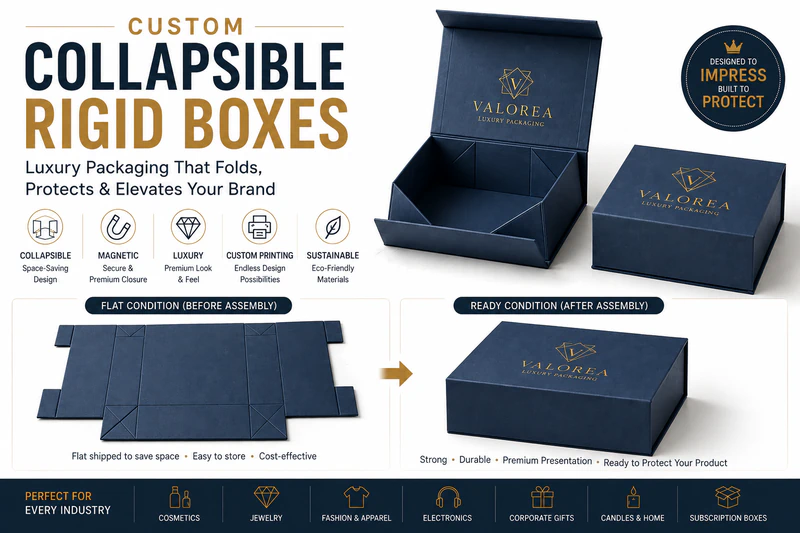
They combine the premium appearance and sturdy feel associated with rigid packaging with a foldable structure that can be stored and transported flat before assembly. When needed, the box can be formed into a strong presentation package suitable for luxury retail, e-commerce, gifting, apparel, cosmetics, jewelry, electronics, candles, and many other premium products.
For brands that want packaging to look impressive without making storage and logistics unnecessarily complicated, collapsible rigid packaging can offer an attractive balance between luxury and practicality.
This complete guide explores how collapsible rigid boxes work, how they differ from traditional rigid boxes and folding cartons, which products they suit best, how materials and closures affect performance, and what brands should consider before ordering custom foldable rigid packaging.
What Are Custom Collapsible Rigid Boxes?
Custom collapsible rigid boxes—also commonly called foldable rigid boxes, flat-pack rigid boxes, or collapsible magnetic boxes—are premium paperboard boxes designed to fold relatively flat when they are not assembled.
Once opened and secured into shape, they provide the structured appearance consumers associate with conventional rigid packaging.
The basic construction usually includes:
- Thick rigid paperboard or greyboard
- Wrapped printed or specialty paper
- Engineered folding points
- Foldable side walls
- Corner locking or adhesive mechanisms
- A hinged lid in many designs
- Concealed magnets in magnetic closure styles
- Optional custom inserts
- Interior and exterior branding
This construction makes the box particularly useful for businesses that order packaging in larger quantities but do not want permanently assembled empty boxes consuming excessive storage space.
A well-designed collapsible rigid box should not look like a compromise when it reaches the customer. Once assembled correctly, the folding mechanism should largely disappear into the structure, leaving a clean and polished presentation.
Why Are Collapsible Rigid Boxes Becoming Popular?
Luxury packaging creates value, but businesses also need packaging that works efficiently within their operations.
Consider a brand receiving thousands of conventional rigid boxes. Every empty box already occupies its full final dimensions. Before a single product is packed, the business needs enough room to receive, organize, store, and move those boxes.
Collapsible boxes approach the same problem differently.
Because the boxes arrive in a flatter configuration, businesses can generally store more units within the same available space. The packaging is assembled closer to the point at which the product is packed.
That makes the format particularly interesting for:
- E-commerce businesses
- Growing direct-to-consumer brands
- Subscription businesses
- Retail companies
- Gift businesses
- Brands importing packaging in bulk
- Businesses with limited warehouse space
- Seasonal product launches
- Corporate gifting programs
The appeal is straightforward: premium presentation on the customer side and greater space efficiency on the business side.
How Does a Collapsible Rigid Box Work?
At first glance, an assembled collapsible box can look very similar to a standard rigid magnetic box. The important difference is hidden within its construction.
Instead of manufacturing the base as a permanently fixed tray, selected panels and corners are engineered so that the structure can remain relatively flat before use.
During assembly, the side walls are raised and secured into position.
Depending on the specific structural design, the corners may use:
- Pre-applied adhesive strips
- Peel-and-seal tabs
- Folding panels
- Locking sections
- Magnetic components
- Other project-specific fastening methods
Once the corners are secured, the flat structure becomes a sturdy three-dimensional box.
For a magnetic version, magnets are typically concealed beneath the paper wrap so that the customer sees a clean exterior rather than exposed hardware.
The result is a box that can provide a satisfying opening and closing experience while retaining the practical advantages of flat storage before assembly.
Collapsible Rigid Boxes vs. Traditional Rigid Boxes
Both packaging formats belong to the premium rigid-box family, but they solve different operational needs.
Traditional Rigid Boxes
A traditional setup rigid box is manufactured and delivered in its finished three-dimensional shape.
Its advantages include:
- Immediate readiness for packing
- Excellent structural consistency
- Premium presentation
- No box assembly required at fulfillment
However, permanently assembled boxes require considerably more storage volume than flat-packed packaging.
For businesses handling large packaging inventories, that difference can become important.
Collapsible Rigid Boxes
Collapsible rigid boxes are engineered to remain flatter until they are required.
Their advantages can include:
- More efficient storage
- More efficient bulk transportation
- Premium rigid-box appearance after assembly
- Easier handling of larger packaging inventories
- Convenient packaging for seasonal campaigns
- Strong customization potential
There is a trade-off: somebody must assemble the box before the product is packed.
For many businesses, however, a short assembly step is worthwhile when compared with storing large volumes of permanently assembled empty boxes.
Collapsible Rigid Boxes vs. Folding Cartons
A collapsible rigid box should not be confused with an ordinary folding carton.
Both can arrive flat, but their construction, feel, positioning, and customer experience are very different.
Folding Cartons
Standard folding cartons are generally manufactured from comparatively thinner paperboard. They are lightweight, economical, and extremely useful for high-volume retail products.
They are common for products such as:
- Cosmetics
- Pharmaceuticals
- Food products
- Small electronics
- Personal care products
- General retail merchandise
Collapsible Rigid Boxes
Collapsible rigid boxes use substantially heavier board to create a more solid presentation.
When a customer picks up the package, the difference is noticeable. A rigid box generally feels heavier and more substantial, which can contribute to a higher perceived product value.
For this reason, collapsible rigid packaging is particularly suitable when the packaging itself is intended to become part of the product experience.
A folding carton says, “This contains the product.”
A thoughtfully designed rigid box can say, “Opening this product is part of the experience.”
Key Benefits of Custom Collapsible Rigid Boxes
The popularity of this packaging style is not based on appearance alone. It can solve several practical business problems at the same time.
1. Premium Brand Presentation
Luxury customers notice details.
The weight of the board, the resistance of the lid, the texture of the paper, the alignment of the corners, and even the sound of a magnetic closure can influence how a product feels.
Collapsible rigid boxes allow brands to preserve much of that premium experience while using a more storage-efficient structure.
2. More Efficient Storage
Empty packaging can consume a surprising amount of warehouse space.
The ability to store collapsible boxes flat or substantially flatter before assembly can make inventory management easier, particularly for businesses ordering packaging in bulk.
3. More Practical Bulk Transportation
Shipping permanently assembled empty boxes means transporting a large amount of unused internal volume.
A flat-pack structure can make transportation more space-efficient before the boxes are filled with products.
The actual freight saving will depend on the box dimensions, packing configuration, order quantity, shipping method, and supplier, so businesses should compare packed-carton specifications rather than assume a fixed percentage saving.
4. Luxury Unboxing Experience
Operational efficiency does not have to be visible to the customer.
Once assembled, a well-made collapsible rigid box can deliver an elegant presentation through features such as:
- Magnetic closure
- Interior printing
- Custom inserts
- Ribbon pulls
- Foil-stamped logos
- Embossed branding
- Soft-touch surfaces
- Printed messages inside the lid
These details turn packaging into part of the brand story.
5. Customization Flexibility
Collapsible rigid boxes can be designed around the product instead of forcing the product into a generic stock package.
Brands can customize:
- Length, width, and depth
- Board thickness
- Exterior colors
- Interior colors
- Printing
- Logo placement
- Inserts
- Closures
- Paper textures
- Finishes
- Accessories
This allows packaging to remain visually consistent with the rest of the brand.
6. Potential for Reuse
A high-quality rigid box often survives long after the original product has been removed.
Customers may reuse attractive boxes for accessories, documents, jewelry, cosmetics, keepsakes, or household storage.
That gives brands an opportunity to remain visible in the customer’s environment beyond the initial purchase.
Popular Types of Collapsible Rigid Boxes
Not every collapsible box needs to look the same. The structure can be adapted according to the product, desired opening experience, and branding strategy.
Magnetic Closure Collapsible Rigid Boxes
This is one of the most recognizable styles.
The box typically features a hinged lid and a front flap containing concealed magnets. When closed, the magnets align with the corresponding section of the base and create a clean closure without an exposed tab.
This style works particularly well for:
- Luxury apparel
- Cosmetics
- Skincare
- Perfumes
- Corporate gifts
- Electronics
- Premium accessories
- Gift collections
The magnetic closure also adds a tactile element to the unboxing experience.
Foldable Gift Boxes
Collapsible rigid gift boxes are designed for presentation-driven products and occasions.
They can be customized for:
- Holiday gifts
- Corporate gifting
- Wedding gifts
- Promotional kits
- Influencer boxes
- Employee welcome kits
- Luxury gift sets
- Subscription packages
Interior printing can make these boxes especially effective because the customer encounters another branded surface as soon as the lid opens.
A short message, pattern, campaign artwork, or brand statement inside the lid can turn a simple package into a more intentional experience.
Collapsible Apparel Boxes
Clothing and fashion products are particularly well suited to collapsible rigid packaging because they often require larger boxes.
The larger the permanently assembled package becomes, the more important storage efficiency can be.
Collapsible apparel boxes can be used for:
- Shirts
- Dresses
- Scarves
- Luxury clothing
- Designer accessories
- Footwear
- Fashion gift sets
Tissue paper, ribbons, branded cards, or custom interior printing can further enhance presentation without requiring complicated inserts.
Collapsible Boxes for Cosmetics and Skincare
Beauty products compete heavily on presentation.
Consumers encounter hundreds of visually polished products, which means packaging must communicate brand positioning almost immediately.
Collapsible rigid boxes can be designed for:
- Skincare sets
- Cosmetic collections
- Perfume
- Makeup kits
- Beauty subscription boxes
- Influencer PR kits
- Product launch collections
Custom inserts become especially valuable when several products of different sizes need to appear neatly arranged inside one package.
Collapsible Rigid Boxes for Jewelry and Accessories
Jewelry packaging requires a different kind of presentation.
Instead of filling the package with visual elements, premium jewelry packaging often benefits from restraint.
A clean exterior, subtle logo, controlled color palette, and fitted insert can create a sophisticated result.
Collapsible rigid packaging can be adapted for:
- Watches
- Bracelets
- Necklaces
- Fashion accessories
- Premium gift sets
Foam, paperboard, fabric-covered, or other fitted inserts can help keep products correctly positioned during presentation.
Collapsible Packaging for Electronics and Premium Products
Electronics packaging must balance aesthetics with protection.
A beautiful box that allows the product to move freely inside is poorly designed, regardless of how impressive the exterior looks.
For electronics and heavier products, structural planning should consider:
- Product weight
- Board strength
- Internal dimensions
- Insert material
- Accessory compartments
- Cable storage
- Product movement
- Closure strength
- Shipping environment
This is why custom packaging should begin with the actual product—not simply with an attractive box design.
The most effective collapsible rigid box is one in which the structure, materials, insert, branding, and product work together as a single packaging system.
The Real Value of Collapsible Rigid Packaging
The biggest advantage of collapsible rigid boxes is not simply that they fold.
Their real value comes from solving two very different requirements at the same time.
The customer wants packaging that feels luxurious.
The business wants packaging that is practical to purchase, transport, store, assemble, and use.
When designed correctly, a collapsible rigid box can serve both.
That combination makes it particularly relevant for modern brands that want to deliver a premium experience without allowing packaging logistics to become unnecessarily inefficient.
Choosing the Right Materials for Collapsible Rigid Boxes
A premium box begins with the right material. Beautiful artwork and expensive finishing cannot compensate for a structure that feels weak, bends under the product’s weight, or loses its shape after assembly.
For custom collapsible rigid boxes, material selection should be based on the product’s weight, box dimensions, desired presentation, shipping conditions, and overall brand positioning.
Rigid Greyboard
Greyboard forms the structural core of most premium rigid boxes. Unlike the thinner paperboard commonly used for folding cartons, rigid greyboard provides the thickness and strength required to create a substantial, luxury feel.
The appropriate board thickness depends on factors such as:
- Box dimensions
- Product weight
- Structural design
- Insert configuration
- Expected handling
- Desired level of rigidity
Using unnecessarily thick board can increase cost and weight, while board that is too thin may make a premium package feel disappointing. The goal is not simply to choose the thickest material available, but to select the right specification for the product.
Premium Paper Wraps
The greyboard provides structure, but the outer paper wrap creates much of the visual and tactile identity.
Brands can choose from a wide range of wrapping papers, including:
- Smooth coated paper
- Uncoated paper
- Textured specialty paper
- Kraft paper
- Linen-effect paper
- Metallic paper
- Soft-touch surfaces
- Custom printed paper
For luxury packaging, the feel of the paper can be almost as important as its appearance.
A customer may see a box for only a few seconds before touching it. Once the package is in their hands, texture becomes part of the brand experience.
The Magnetic Closure Mechanism
Magnetic closure is one of the most popular features in collapsible rigid packaging.
Instead of using a visible locking tab, magnets are concealed beneath the wrapped paperboard. When the lid closes, the magnetic components align and hold the package shut.
A properly engineered magnetic closure should feel smooth and intentional.
The closure should be strong enough to keep the box securely closed during normal handling, but it should not require excessive force to open.
Several factors influence the performance of the closure:
- Magnet size
- Magnet positioning
- Board thickness
- Paper thickness
- Lid dimensions
- Product weight
- Structural alignment
Poor alignment can result in a lid that does not close correctly, which is why prototype testing is important before mass production.
The small moment when a customer closes the lid and feels it settle into position may seem insignificant, but in premium packaging, these tactile details contribute to the overall perception of quality.
Custom Inserts: Protecting the Product Inside
A beautiful exterior creates the first impression. The insert determines what happens when the box is opened.
Without a properly designed insert, products may move, collide, tilt, or appear poorly arranged inside the package.
Custom inserts solve this problem by creating dedicated positions for individual products.
EVA Foam Inserts
EVA foam is commonly used when a precise, premium fit is required.
It can be die-cut according to the shape of the product and works particularly well for:
- Electronics
- Watches
- Jewelry
- Glass products
- Premium accessories
- Presentation kits
Foam can also be covered or finished to create a more refined appearance.
Paperboard Inserts
Paperboard inserts offer a clean presentation and can be printed to coordinate with the rest of the packaging.
They are useful for:
- Cosmetics
- Skincare
- Gift sets
- Bottles
- Small accessories
- Retail collections
For brands prioritizing fiber-based packaging, paperboard inserts can also reduce reliance on plastic-based components where the product and protection requirements allow it.
Molded Fiber Inserts
Molded fiber can be an attractive option when protection and material efficiency are priorities.
Its suitability depends on the product shape, weight, presentation requirements, and desired finish.
Fabric-Covered Inserts
For jewelry, watches, premium gifts, and high-end presentation boxes, fabric-covered inserts can create a softer and more luxurious interior.
Velvet-like surfaces and other textile finishes can add visual depth while helping the product feel more carefully presented.
Printing Options for Custom Collapsible Rigid Boxes
The structure gives the box its form. Printing gives it personality.
The most effective packaging does not simply cover every available surface with graphics. Instead, it uses printing strategically to communicate the brand clearly.
Popular printing approaches include:
- CMYK printing
- Pantone color matching
- Offset printing
- Digital printing for suitable applications
- Interior printing
- Pattern printing
- Custom brand artwork
CMYK Printing
CMYK is useful for designs containing multiple colors, gradients, illustrations, and photographic elements.
It provides flexibility for brands with visually detailed packaging.
Pantone Color Matching
For brands where exact color consistency is particularly important, Pantone matching can help maintain a more controlled appearance across packaging runs and different branded materials.
Color consistency matters because customers gradually associate specific colors with a brand.
Premium Finishing Options
Printing communicates information. Finishing changes how the packaging feels.
Luxury brands often use finishing techniques selectively rather than applying everything at once.
Foil Stamping
Foil stamping can add metallic detail to:
- Logos
- Product names
- Borders
- Patterns
- Small graphic elements
Popular options include gold, silver, rose gold, copper, and other metallic effects.
A restrained foil logo on a minimalist box can often create a stronger premium impression than a heavily decorated design.
Embossing
Embossing raises selected elements above the surrounding surface.
It works especially well for:
- Logos
- Monograms
- Brand symbols
- Patterns
- Premium typography
Because customers can physically feel the raised area, embossing adds another sensory layer to the packaging.
Debossing
Debossing creates the opposite effect by pressing artwork into the surface.
The result can be understated and sophisticated, making it particularly suitable for minimalist luxury branding.
Spot UV
Spot UV creates contrast by adding gloss to selected areas while leaving the surrounding surface comparatively matte.
It can highlight a logo, pattern, or specific design element without changing the entire package.
Soft-Touch Lamination
Soft-touch lamination creates a smooth, velvety feel that is frequently associated with premium packaging.
It works particularly well with:
- Minimalist designs
- Dark packaging
- Luxury cosmetics
- Fashion products
- Premium electronics
- Gift packaging
Matte and Gloss Lamination
Matte lamination produces a softer, more understated appearance, while gloss lamination creates greater shine and color intensity.
The right choice depends on the personality of the brand rather than on which finish is inherently “better.”
Designing Collapsible Rigid Boxes That Customers Remember
Good packaging design begins with understanding the customer.
A luxury fashion brand and a natural skincare company may use the same basic collapsible structure but should not necessarily look or feel the same.
The packaging should visually answer a simple question:
What kind of brand is this?
Keep the Design Focused
Premium does not mean complicated.
Too many colors, fonts, icons, claims, patterns, and finishes can make expensive packaging look less sophisticated.
A clear hierarchy usually works better:
- Brand logo
- Product or collection name
- One strong visual direction
- Supporting information where necessary
Allowing empty space around important elements can make them feel more intentional.
Design the Inside as Carefully as the Outside
The exterior attracts attention, but the interior creates the reveal.
Consider using the inside lid for:
- A short brand message
- Campaign artwork
- A thank-you statement
- Instructions
- A QR code
- A subtle pattern
- Social media information
The goal is not to fill every surface. It is to create a sequence of small discoveries as the customer opens the package.
Common Collapsible Rigid Box Mistakes to Avoid
Collapsible rigid packaging involves more structural engineering than an ordinary printed carton. Small mistakes can therefore become highly visible.
Choosing the Box Before Measuring the Product
The product should determine the packaging dimensions—not the other way around.
Accurate measurements should consider the product itself, protective clearance, inserts, accessories, and the intended presentation.
Ignoring Product Weight
A structure designed for a lightweight scarf may not be appropriate for a heavy glass set or electronic device.
Board strength, closure design, and insert construction should match the actual packed weight.
Using an Insert That Looks Good but Does Not Protect
An insert should not be selected only because it appears luxurious.
Its first job is to hold the product securely.
The product should be tested for movement before mass production.
Overusing Premium Finishes
Foil, embossing, Spot UV, metallic paper, patterns, and multiple colors can all look beautiful individually.
Using all of them together does not automatically create better packaging.
Luxury is often achieved through restraint.
Ignoring Assembly Experience
Remember that collapsible boxes must be assembled.
If employees or fulfillment teams struggle to form the box correctly, operational efficiency disappears.
A good structure should be reasonably intuitive, repeatable, and consistent.
Skipping the Prototype Stage
A digital rendering can show how artwork may look, but it cannot fully demonstrate:
- Board stiffness
- Magnet strength
- Paper texture
- Insert fit
- Corner alignment
- Assembly experience
- Actual product fit
For important packaging projects, a physical sample or prototype can reveal issues before thousands of boxes are produced.
Quality Control Matters More Than It Appears
Luxury packaging is unforgiving.
A minor defect that might go unnoticed on an inexpensive shipping carton can become obvious on a premium presentation box.
Important quality points include:
- Clean corners
- Consistent wrapping
- Correct magnet alignment
- Accurate dimensions
- Smooth folding points
- Strong adhesive areas
- Consistent color
- Proper foil registration
- Clean embossing or debossing
- Correct insert dimensions
- Proper lid alignment
For businesses ordering custom packaging, approving specifications and samples carefully before production can prevent expensive problems later.
Sustainable Collapsible Rigid Packaging
Sustainability has become increasingly important to both brands and customers, but responsible packaging decisions require more than adding an “eco-friendly” label.
A better approach is to examine the entire packaging system.
Brands can consider:
- Responsibly sourced paper
- Recycled-content paper where appropriate
- Fiber-based inserts
- Reduced plastic components
- Efficient box sizing
- Minimal unnecessary material
- Reusable structures
- Packaging designed for easier material separation
However, recyclability can depend on the complete construction—not simply the outer paper.
Magnets, laminations, adhesives, foam inserts, metallic components, and mixed materials can affect how easily a package can move through a recycling system.
For this reason, sustainability claims should be specific and supportable rather than vague.
Instead of simply saying “100% eco-friendly,” brands should understand what the box is made from and communicate environmental attributes accurately.
How Collapsible Design Can Reduce Packaging Waste Behind the Scenes
Sustainability is not limited to what happens after the customer opens the package.
Operational efficiency also matters.
Because collapsible rigid boxes can be transported and stored in a flatter configuration, businesses may be able to use storage and freight space more efficiently than with comparable permanently assembled empty boxes.
Another important consideration is sizing.
A beautifully designed box that is much larger than the product may use unnecessary material, require a larger shipping carton, and increase the amount of void space being transported.
Good packaging engineering aims to create enough room for protection and presentation without making the package unnecessarily oversized.
Selecting the Right Box for Your Industry
The best collapsible rigid box is not universal.
Different industries have different priorities.
Fashion and Apparel
Focus on:
- Large presentation area
- Interior printing
- Tissue paper
- Ribbon
- Easy assembly
- Premium surface finishes
Cosmetics and Skincare
Focus on:
- Precise inserts
- Clean branding
- Product organization
- Premium finishes
- Strong color consistency
Jewelry and Watches
Focus on:
- Secure fitted inserts
- Controlled product movement
- Elegant textures
- Minimal branding
- High-quality interior presentation
Electronics
Focus on:
- Structural strength
- Product protection
- Accessory organization
- Durable inserts
- Accurate fit
Corporate Gifts and PR Kits
Focus on:
- Multiple product compartments
- Strong brand storytelling
- Interior printing
- Personalized presentation
- Memorable unboxing
The packaging structure should follow the needs of the product rather than forcing every product category into the same box.
From Packaging Idea to Production-Ready Box
Successful custom packaging usually begins with information rather than artwork.
Before requesting a quote, a brand should ideally know:
- Product dimensions
- Product weight
- Number of products per box
- Preferred box style
- Approximate order quantity
- Insert requirements
- Printing requirements
- Desired finishes
- Delivery destination
- Target launch date
Providing accurate information early makes it easier to develop a realistic packaging specification and reduces unnecessary revisions later.
Once the basic structure has been established, artwork, finishing, prototypes, and production details can be refined around it.
For premium collapsible rigid packaging, this process is worth the effort. The finished box is not merely something that surrounds the product. It becomes part of how customers experience, remember, and judge the brand.
Wholesale Collapsible Rigid Boxes: What Brands Should Know Before Ordering
Ordering custom packaging in larger quantities is very different from purchasing ready-made stock boxes. With custom collapsible rigid boxes, decisions about dimensions, materials, construction, inserts, printing, and finishing all influence the final result.
A successful wholesale order begins with a clear understanding of what the packaging needs to accomplish.
Before requesting production, brands should consider the complete journey of the box—from arriving flat at the warehouse to being assembled, filled, shipped, opened, and potentially reused by the customer.
Start With Accurate Product Dimensions
Small measurement errors can create surprisingly large packaging problems.
Before determining the final box size, measure the actual product and consider:
- Product length
- Product width
- Product height
- Product weight
- Protective clearance
- Insert thickness
- Accessories included in the box
- Printed materials or instruction cards
If multiple products will be packed together, their final arrangement should be planned before the box dimensions are finalized.
The objective is to achieve a secure fit without creating unnecessary empty space.
Determine the Right Order Quantity
Order quantity can significantly influence the unit cost of custom packaging.
Larger production runs often spread setup and manufacturing costs across more units. However, ordering more packaging than the business can realistically use may create unnecessary inventory.
The right quantity should consider:
- Expected sales volume
- Available storage
- Product launch schedule
- Seasonal demand
- Future artwork changes
- Packaging redesign plans
Collapsible construction can make larger inventories easier to manage because unassembled boxes require less storage volume than comparable setup rigid boxes.
Why Sampling Is Important Before Mass Production
For premium packaging, a sample can answer questions that a digital mockup cannot.
A screen can show artwork and approximate colors, but it cannot fully communicate how the finished box will feel in your hands.
A physical sample allows you to evaluate:
- Box dimensions
- Product fit
- Board rigidity
- Corner construction
- Folding performance
- Magnetic closure
- Insert fit
- Paper texture
- Print appearance
- Foil placement
- Overall unboxing experience
This becomes especially important when ordering thousands of units.
Finding a structural problem during sampling is inconvenient. Finding the same problem after mass production is considerably more expensive.
What Affects the Cost of Custom Collapsible Rigid Boxes?
There is no single price for custom collapsible rigid packaging because every project has different specifications.
Several factors influence the final cost.
Box Size
Larger boxes generally require more greyboard, wrapping paper, and production material.
Size can also influence shipping and master-carton efficiency.
Board Thickness
Heavier products may require stronger board.
However, increasing thickness unnecessarily can add cost and weight without delivering meaningful additional value.
Order Quantity
Quantity is one of the most important pricing factors.
Higher production volumes can often reduce the per-unit manufacturing cost.
Printing
A minimalist one-color design and a detailed full-color printed box have different production requirements.
Color matching and interior printing can also affect pricing.
Premium Finishes
Features such as:
- Foil stamping
- Embossing
- Debossing
- Spot UV
- Soft-touch lamination
- Specialty paper
can increase the cost but may also significantly improve perceived value.
Custom Inserts
The material and complexity of the insert affect pricing.
A simple paperboard divider will generally have different production requirements from a precision-cut premium insert.
Accessories
Additional elements may include:
- Ribbon pulls
- Handles
- Printed cards
- Sleeves
- Tissue paper
- Product trays
- Decorative accessories
Each element should have a clear purpose rather than being added simply because it is available.
How to Control Packaging Costs Without Making the Box Look Cheap
Reducing cost does not necessarily mean reducing quality.
Smart packaging decisions can often protect the premium appearance while avoiding unnecessary expenses.
One approach is to choose one or two high-impact finishing techniques instead of combining every available option.
For example, a clean printed box with a carefully positioned foil logo may create a stronger luxury impression than a design containing foil, Spot UV, embossing, multiple textures, and several decorative accessories at once.
Brands can also control costs by:
- Optimizing box dimensions
- Avoiding excessive empty space
- Selecting the appropriate board thickness
- Using efficient insert designs
- Standardizing box sizes across related products where practical
- Planning larger production runs carefully
- Finalizing artwork before production
- Choosing finishes strategically
The goal should be better packaging value, not simply the lowest packaging price.
Collapsible Rigid Packaging Trends for 2026
Luxury packaging continues to change as brands balance premium presentation with operational efficiency and more thoughtful material choices.
Several trends are particularly relevant to collapsible rigid packaging.
Minimalist Luxury
Luxury packaging is becoming increasingly restrained.
Instead of filling the box with decorative elements, brands are using:
- Clean typography
- Controlled color palettes
- Small foil details
- Subtle embossing
- High-quality textured papers
- Generous negative space
The result feels confident rather than crowded.
Interior Brand Storytelling
The inside of the box is increasingly becoming part of the marketing experience.
Brands are using interior surfaces for:
- Short brand stories
- Product instructions
- Thank-you messages
- Campaign artwork
- QR codes
- Social media prompts
This creates an additional customer touchpoint without affecting the clean exterior design.
Reusable Packaging
Premium boxes that customers want to keep can extend the useful life of the package.
A well-designed collapsible rigid box may later be used for accessories, documents, cosmetics, keepsakes, or household organization.
For brands, this can mean longer-lasting visibility inside the customer’s home or workplace.
More Thoughtful Material Selection
Brands are paying closer attention to how different materials work together rather than relying on broad environmental claims.
Paper-based inserts, reduced plastic components, efficient sizing, responsibly sourced paper options, and designs that avoid unnecessary material are increasingly important considerations.
Unboxing Designed for Social Media
Unboxing has become part of modern product marketing.
A customer opening an attractive package may photograph or record the experience for Instagram, TikTok, YouTube, or other platforms.
This makes details such as interior printing, product arrangement, lid opening, and presentation more important than ever.
How Packaging Can Influence Perceived Product Value
Imagine two brands selling similar premium products at approximately the same price.
The first product arrives inside an ordinary stock carton with a printed sticker.
The second arrives in a precisely fitted collapsible rigid box with a clean exterior, subtle foil logo, smooth magnetic closure, and an organized custom insert.
Before either product has been used, the second brand has already communicated something important:
Attention has been paid to the details.
That perception can influence how customers evaluate the product itself.
Packaging cannot turn a poor product into a good one. However, excellent packaging can help a good product communicate its value more effectively.
This is particularly important for products purchased as gifts, premium collections, corporate presentations, influencer kits, and luxury retail items.
Why Choose Prime Box Packaging for Custom Collapsible Rigid Boxes?
Creating successful custom packaging requires more than printing a logo on an existing box.
The dimensions, board, folding structure, closure, insert, artwork, finishing, and final presentation need to work together.
Prime Box Packaging provides custom packaging solutions for brands looking to create packaging around their actual products and branding requirements.
Available options can include:
- Custom Collapsible Rigid Boxes
- Magnetic Closure Boxes
- Luxury Rigid Boxes
- Custom Gift Boxes
- Shoulder and Neck Rigid Boxes
- Custom Slide & Match Style Boxes
- Custom Inserts
- Custom Packaging Sleeves
- Premium Printing
- Foil Stamping
- Embossing and Debossing
- Spot UV
- Matte and Gloss Finishes
- Soft-Touch Finishes
- Custom Sizes and Structures
Whether the packaging is being developed for cosmetics, apparel, jewelry, candles, electronics, corporate gifts, or another premium product category, the objective remains the same: create a box that protects the product while presenting the brand professionally.
For growing businesses, collapsible construction can add another advantage by making premium packaging inventory more practical to store and manage.
Frequently Asked Questions About Collapsible Rigid Boxes
What are collapsible rigid boxes?
Collapsible rigid boxes are premium paperboard boxes designed to fold into a relatively flat configuration for transportation and storage and then assemble into a sturdy three-dimensional package before use.
Are collapsible rigid boxes the same as folding cartons?
No. Although both can be supplied flat, collapsible rigid boxes generally use substantially thicker rigid board and are designed to provide a more substantial, premium presentation than conventional folding cartons.
Are magnetic closure collapsible boxes available?
Yes. Magnetic closure is one of the most popular configurations for collapsible rigid packaging. Magnets can be concealed within the wrapped structure to create a clean exterior and convenient opening and closing experience.
Can I customize the size of a collapsible rigid box?
Yes. Custom boxes can be manufactured around the dimensions and requirements of the product. Product size, weight, inserts, accessories, and desired presentation should all be considered before dimensions are finalized.
Can custom inserts be added?
Yes. Depending on the product, inserts may be made from paperboard, foam, molded fiber, fabric-covered materials, or other suitable materials. The primary purpose of an insert is to keep the product properly positioned and protected.
What printing and finishing options are available?
Options can include CMYK printing, Pantone color matching, foil stamping, embossing, debossing, Spot UV, matte or gloss lamination, soft-touch finishes, specialty papers, and interior printing.
Are collapsible rigid boxes suitable for luxury products?
Yes. When properly designed and manufactured, they can be used for cosmetics, fashion, jewelry, candles, electronics, premium gifts, PR kits, corporate gifts, and many other high-end products.
Do collapsible rigid boxes save storage space?
Their foldable construction generally allows empty boxes to occupy less storage volume before assembly than comparable permanently assembled rigid boxes. The actual space difference depends on the specific box structure and dimensions.
Are collapsible rigid boxes recyclable?
That depends on the complete construction and local recycling system. Paperboard may be recyclable, but magnets, laminations, adhesives, foam, metallic components, and other mixed materials can affect recyclability. Brands should evaluate the entire packaging specification before making environmental claims.
Should I order a sample before bulk production?
For a custom premium packaging project, sampling is highly valuable. It allows the brand to evaluate product fit, structure, assembly, materials, closure performance, printing, and finishing before committing to mass production.
What products work best with collapsible rigid packaging?
These boxes are particularly useful for premium products where presentation matters, including apparel, cosmetics, skincare, perfumes, jewelry, watches, candles, electronics, gift sets, influencer kits, subscription collections, and corporate gifts.
Final Thoughts
Premium packaging should not force a business to choose between presentation and practicality.
Custom collapsible rigid boxes bring these two priorities together.
For the customer, the package can feel substantial, refined, and carefully designed. It can feature a magnetic closure, premium paper, custom printing, a fitted insert, and a memorable product reveal.
For the business, the same packaging can remain relatively flat before assembly, making larger quantities more practical to transport, organize, and store.
That balance is what makes collapsible rigid packaging particularly valuable for modern brands.
However, the structure alone does not create premium packaging.
The strongest results come from getting the fundamentals right: accurate product measurements, appropriate board strength, a secure insert, reliable closure, clean artwork, controlled finishing, careful sampling, and consistent production quality.
When all of these elements work together, the box stops feeling like an accessory added at the end of product development.
It becomes part of the product experience itself.
Ready to Elevate Your Brand with Custom Collapsible Rigid Boxes?
Your customer may spend weeks comparing products, but it can take only a few seconds for packaging to create an impression.
Make those seconds count.
Whether you need magnetic collapsible boxes for a luxury collection, foldable gift boxes for corporate gifting, premium packaging for cosmetics and apparel, or a completely custom structure built around your product, Prime Box Packaging can help you develop packaging that combines presentation with practicality.
Choose the dimensions, materials, printing, finishing, inserts, and structural details that fit your product and brand.
Get a Quick Quote today and explore custom collapsible rigid packaging designed to protect your products, elevate your presentation, and create an unboxing experience customers remember.